
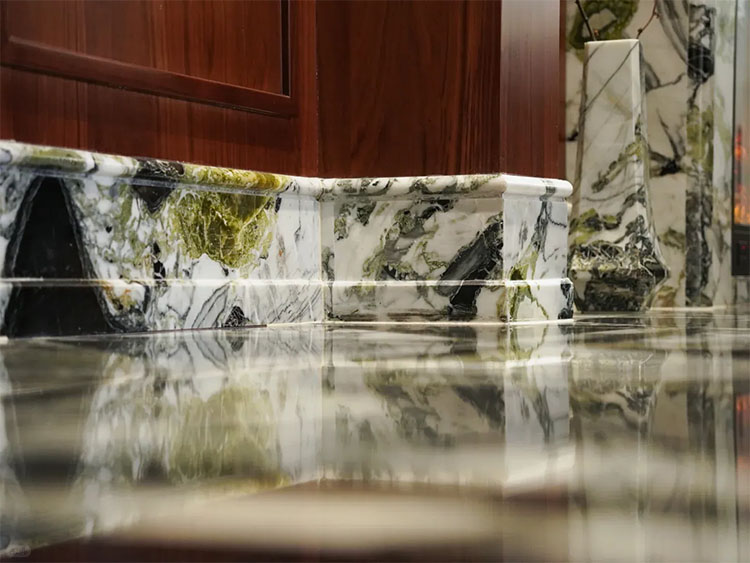
When doing interior decoration, marble wall skirting need to be installed in the corners of public areas (living room, dining room, hallways, staircases, etc.). Natural marble, with its natural luster and veining, combined with various styles and designs, is an excellent choice for skirting baseboards. What are the common sizes and styles for marble skirting? And what are some suggestions for installing marble skirting?
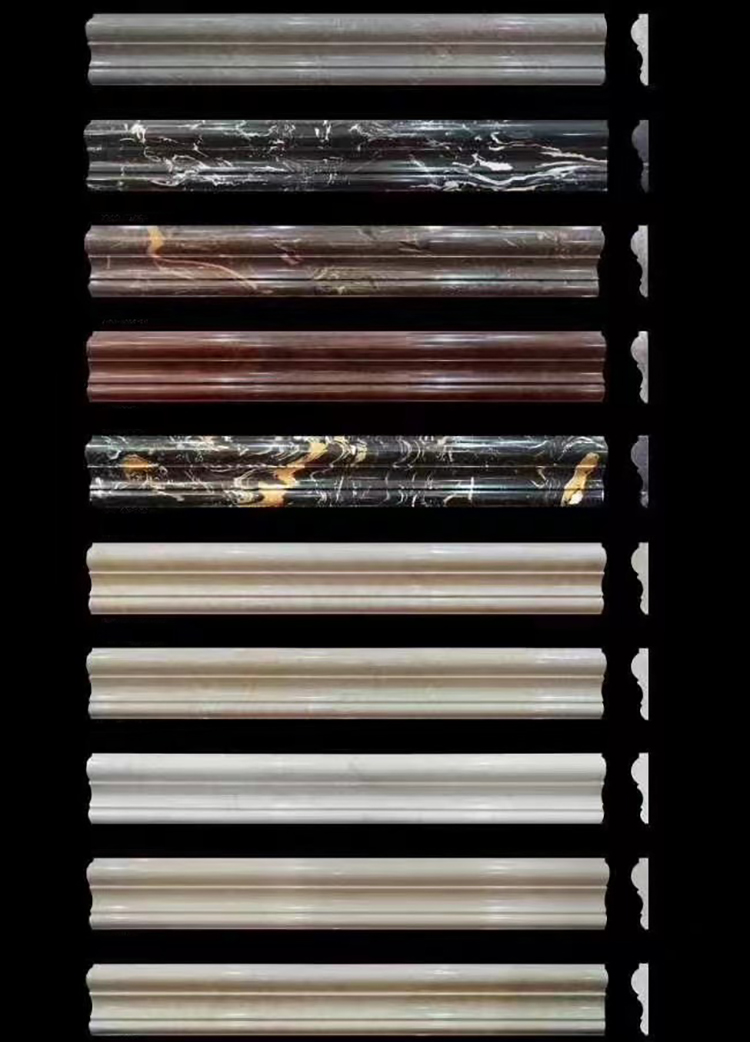
Black and grey marble is commonly used for marble skirting. When utilizing natural marble as skirting, it is typically installed directly to the wall surface, resulting in the skirting overlapping the wall and protruding by a layer of stone thickness. For a seamless transition at corners, place the skirting at a right angle. Marble skirting on a flat wall should be fitted in a straight line, with no excess or gaps that need to be filled with putty.

Style 1: Single-sided.
The top edge of the marble skirting is beveled or rounded at a 5mm*5mm angle. Simple and ideal for a minimalist, understated premium look.
Style 2: Single-sided with Grooving.
The top edge of the baseboard is ground with a 5mm*5mm bevel or tiny rounded edge, and a 3mm to 15mm groove is dragged forward from there. Simple but tasteful, ideal for a minimalist, understated premium look.


Style 3: Lines
The upper half of the skirting is completed with lines that are 30-80mm thick. This style has a more complicated design, which improves aesthetics and makes it appropriate for more sophisticated styles like European, American, and French designs.
What things should you avoid while installing stone skirting boards?
01. It is not suggested to make them too high or too low.
Natural marble skirting ranges in height from 80mm to 200mm. Skirting shorter than 80mm is too thin and prone to breakage, whilst skirting higher than 200mm is excessively high and detracts from the appearance. Minimalist luxury baseboards are normally 80mm-120mm tall, although European, American, and French versions are significantly taller, ranging from 120mm to 200mm. As a result, the height of the baseboards varies according to style.


02. It is not suggested to embed marble skirting in the wall surface.
First, because marble skirting must be flat with the wall, the wall must be dismantled first, which raises labor expenses. Furthermore, changes in the overall wall surface might cause inconsistencies in finishing at the intersection of the marble skirting and the wall. Second, if the marble skirting is flush with the wall and plaster is utilized, cracks are likely to appear over time. When wallpaper or wall coverings are used, the top edge of the marble skirting tile is difficult to finish, which can result in an ugly appearance and impact the entire effect. Finally, it increases the difficulty of future skirting replacements. Marble baseboards are often placed directly to the wall surface.


03 Stone baseboards are not recommended for wood flooring.
Wooden flooring is not ideal for stone skirting since it will result in a mismatched and disorganized overall appearance. Wood baseboards are the best option.


04 It is not advisable to draw deep or broad grooves without polishing.
When deep grooves are cut into marble skirting boards, the design is obscured and difficult to clean, gathering dirt and grime quickly. Wide grooves, on the other hand, will not highlight the visual appeal if they are not polished. As a result, the grooves in stone skirting boards are typically 3mm deep. Wide grooves must be polished, and their width should not exceed 25mm.


In addition to the marble skirting mentioned above, we can also provide artificial stone skirting boards and ceramic tile mosaic skirting boards. Artificial stone has stable, even patterns and is reasonably priced. Ceramic mosaic offers distinctive textures and vibrant colors for balconies and bathrooms. You can make a decision based on your budget, style, and location.


Post time: Jul-01-2026